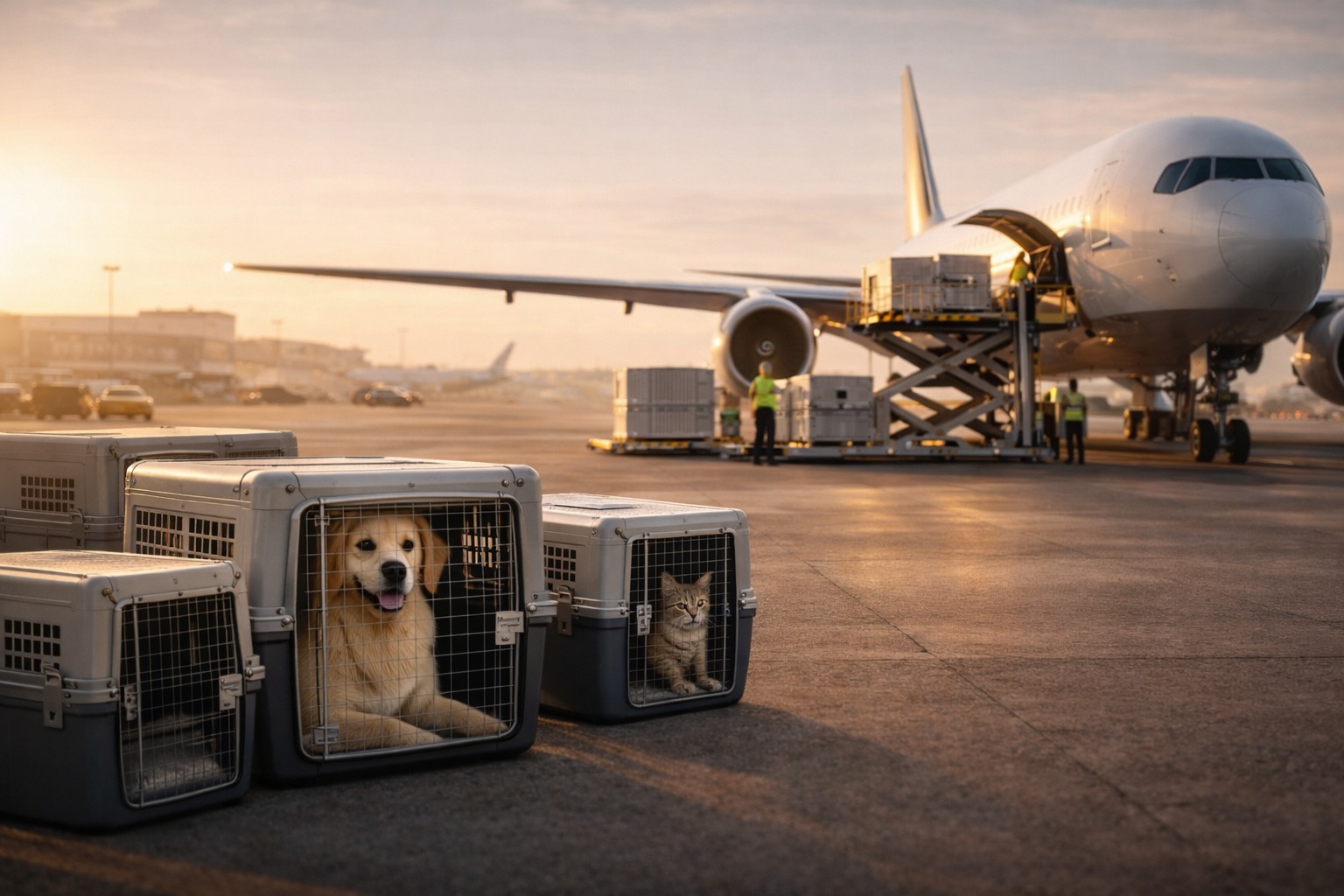
Live Animal Air Transport Guide: Safe, Legal Shipping | Skyways Air
Live Animal Air Transport Guide: Safe, Legal Shipping | Skyways Air
Transporting live animals requires expertise, meticulous planning, and strict compliance with international regulations. Whether you are relocating a cherished pet, a prized racehorse, or a rare species for conservation efforts, understanding the full process ensures every animal travels safely, comfortably, and in full compliance with the rules.
What Is Live Animal Transportation And Why Does It Demand Specialization?
Live animal air transport is not standard cargo logistics. Animals experience stress, require controlled environments, and are governed by a complex web of airline protocols, customs regulations, and international frameworks. A single documentation gap or an improperly sized crate can delay or derail an entire shipment and put the animal’s welfare at risk.
This holds true whether you are arranging live animal transportation services for a family pet, coordinating the relocation of livestock, managing a zoological transfer, or moving an exotic species for conservation. Every journey demands the same foundational commitment: safety, humane treatment, and full regulatory compliance.
Types of Live Animal Transportation Services
Relocation of Pets
The relocation of pets — dogs, cats, birds, and other domestic animals — is the most frequently arranged form of live animal transportation. Whether moving across India or internationally, pets require:
- A valid veterinary health certificate
- Up-to-date vaccination records
- A microchip
- An IATA-compliant travel crate correctly sized for the specific animal
For international pet relocation services from India, an import permit (NOC), an AQCS (Animal Quarantine and Certification Service) certificate, and destination-country documentation are typically required. Requirements vary significantly by country, so preparation should begin at least 8–12 weeks before the intended travel date.
Relocation of Livestock
Livestock transportation — covering horses, cattle, poultry, and other farm animals — demands purpose-built infrastructure. A prized racehorse, for example, requires:
- A dedicated stall with padded partitions
- Pre-travel veterinary clearance
- Careful flight routing to minimise transit time
Ventilation, feed schedules, and humane containment throughout the journey are governed under India’s Prevention of Cruelty to Animals (Transport of Animals) Rules, 2001.
Relocation of Exotic Species
The relocation of exotic species is the most tightly regulated category of live animal transport. All species listed under the Convention on International Trade in Endangered Species (CITES) require valid CITES permits at both origin and destination. India’s Wildlife Protection Act, 1972, adds further restrictions — movement of scheduled wildlife without proper legal procurement certificates is a criminal offence.
Zoological Transfers
Zoological transfers — animals moving between accredited zoos, sanctuaries, or breeding programmes — serve critical conservation purposes. These transfers:
- Follow protocols set by India’s Central Zoo Authority (CZA)
- Often involve quarantine periods at both ends
- Require detailed veterinary documentation including fitness-to-fly assessments
The Live Animal Transport Process: Four Stages of Care
Stage 1 — Pre-Travel Consultation: Comprehensive Planning for a Stress-Free Journey
The foundation of a successful live animal transport begins with thorough planning. A detailed consultation assesses the specific needs of the animal — species, size, health status, origin, destination, and applicable regulations — before a single booking is made.
Key elements addressed at this stage:
- Regulatory compliance: Navigating the complexities of IATA Live Animal Regulations (LAR), CITES permits, and country-specific import and export requirements
- Health and veterinary checks: Coordination with licensed veterinarians to obtain health certificates, vaccination records, and fitness-to-fly approvals
- Customized travel plan: Identifying the best flight routes, layovers, and airline partners to minimise transit time and reduce stress on the animal
For domestic pet transport within India, this stage also involves checking airline-specific breed restrictions — for instance, brachycephalic (snub-nosed) dog breeds face acceptance restrictions at certain temperatures and must be confirmed in advance.
Stage 2 — Safe and Comfortable Crating: Custom-Designed Enclosures for Maximum Protection
Proper containment is critical to ensuring the safety and well-being of the animal throughout transit. IATA Live Animal Regulations specify precise requirements for crate dimensions, materials, ventilation, and labelling for every species category.
What a compliant, well-designed crate provides:
- Size and species-specific design: Each crate is built to match the animal’s size, weight, and natural movement needs — the animal must be able to stand, turn around, and lie down naturally
- Ventilation and safety features: Well-ventilated enclosures that allow optimal airflow while preventing overheating or dehydration
- Non-toxic, absorbent flooring: Moisture-absorbent, non-toxic materials inside the crate ensure hygiene and comfort throughout the journey
“Live Animal” directional labels are affixed on all sides of the crate, and food and water containers are positioned to be accessible from outside during transit.
Stage 3 — Secure Transit and Monitoring: Continuous Supervision for Stress-Free Travel
Once the animal is in transit, real-time monitoring and constant communication between all involved parties ensure the journey remains on course.
Critical elements during transit:
- Dedicated animal handling teams: Trained professionals manage the animal at every stage — from check-in and loading through layovers and final arrival
- Temperature and pressure control: Temperature-sensitive species travel under controlled conditions in specially designated holds; all major airline cargo holds maintain appropriate ventilation and temperature ranges
- Emergency preparedness: Contingency plans are in place to address unexpected delays, reroutes, or health concerns that arise mid-journey
Choosing the right airline partner is also part of this stage. Not all airlines accept all species. The best live animal transportation services by air match each shipment to the most suitable airline and routing — prioritising direct flights to minimise stress.
Stage 4 — Final Delivery and Care: Ensuring a Smooth Arrival
The journey does not end at the destination airport. Careful oversight of the final leg ensures the animal transitions into its new environment smoothly and safely.
This final stage covers:
- Customs clearance and documentation support: Facilitating seamless customs clearance to minimise hold-ups at the port of entry
- Final veterinary inspection: Where required, arranging post-travel health checks to confirm the animal has arrived in good condition
- Safe handover and acclimatisation support: Supporting a smooth transition into the new environment — reducing the stress of the overall change
How to Choose the Right Vehicle for Transporting Live Animals Safely
For the ground segment of any live animal transportation — to and from the airport, or for domestic road transport — the vehicle choice is as important as the air portion.
Key considerations for safe ground transport:
| Consideration | Requirement |
|---|---|
| Climate control | Air-conditioned vehicles essential in India’s climate |
| Secure crate anchoring | Crates must be fixed and cannot shift during transit |
| No chemical exposure | Vehicles must be free of pesticides, fragrances, or exhaust contamination |
| Handler access | Animal must be observable and accessible throughout the journey |
| Species-specific equipment | Large animals such as horses require purpose-built livestock trailers with padded partitions |
Best Carriers for Long-Distance Cat Travel
Cats are particularly sensitive to transport stress. For long-distance cat travel by air, the carrier must:
- Be a hard-shell design with adequate ventilation on all four sides
- Provide enough interior space for the cat to stand, turn, and lie down
- Have secure latching mechanisms that prevent accidental opening
- Be lined with familiar bedding to reduce anxiety
- Comply with IATA Live Animal Regulations for cargo hold travel
Soft-sided carriers are generally not accepted for cargo hold placement and are only appropriate for short journeys or in-cabin travel where permitted.
Legal Framework for Live Animal Transport in India
Understanding the legal landscape protects both the animal and the person arranging the transport.
| Legislation | Scope |
|---|---|
| Prevention of Cruelty to Animals Act, 1960 | India’s foundational animal welfare law, covering handling and transport standards |
| Transport of Animals Rules, 2001 | Specific rules for vehicle standards, maximum journey duration, and handling procedures |
| Wildlife Protection Act, 1972 | Prohibits transport of scheduled wildlife without proper permits; Sections 44–49 are directly relevant to birds and exotic species |
| CITES | India is a signatory; the Wildlife Crime Control Bureau (WCCB) enforces compliance domestically |
| IATA Live Animal Regulations (LAR) | The international standard followed by airlines worldwide, updated annually |
For Maharashtra-based shipments, the AQCS Regional Office handles import and export health certifications. Mumbai’s proximity to Chhatrapati Shivaji Maharaj International Airport (BOM) makes it a key port of entry and departure for international live animal air transport from western India.
FAQ: Transporting Live Animals by Air
What documents are required for domestic pet transport within India? For domestic flights, you generally need a veterinary health certificate, vaccination records, and an IATA-compliant crate. Individual airline policies may require advance booking and breed-specific clearances.
What is the safest way to transport a dog by air within India? Book a direct flight to minimise transit time, use an IATA-approved hard-sided crate properly sized for your dog, obtain a health certificate from a licensed vet within 10 days of travel, and work with an experienced live animal transportation service that coordinates the booking and handling directly with the airline.
How do I arrange international pet relocation from India? International relocation requires a microchipped, vaccinated animal; a health certificate; an import permit from the destination country; and often an AQCS export certificate. Confirm the destination country’s specific requirements at least 8–12 weeks before the intended travel date, as processing times vary significantly.
Can exotic species travel on commercial flights? CITES-listed species require valid permits and typically cannot travel on standard passenger aircraft. They are usually transported on dedicated cargo flights with specialised handling arrangements. India’s Wildlife Protection Act applies additional restrictions on scheduled species.
How long can a cat or dog safely travel by air? Most healthy adult cats and dogs can tolerate flights of up to 12 hours in a well-ventilated, temperature-controlled cargo hold. Very young animals, senior animals, and brachycephalic breeds require extra caution and shorter routing where possible.
What should I look for when choosing a live animal transportation service? Look for IATA accreditation, membership in IPATA (International Pet and Animal Transportation Association), demonstrated experience with your species, in-house veterinary coordination, transparent documentation guidance, dedicated animal handling teams, and clear contingency planning.
What are the risks of poorly managed live animal transportation? Risks include animal distress or injury, regulatory seizure at customs, legal penalties under India’s Wildlife Protection Act or Prevention of Cruelty to Animals Act, and in serious cases, the death of the animal due to inadequate temperature control, poor ventilation, or improper handling.
Key Takeaways
Whether you are arranging the relocation of pets, livestock, exotic species, or zoological collections, transporting live animals by air is a specialised discipline that demands precision at every stage. The four core stages — pre-travel consultation, IATA-compliant crating, monitored transit, and careful final delivery — are each essential to a safe outcome. India’s legal framework adds additional layers, particularly for wildlife and exotic species. For anyone navigating this process, working with a knowledgeable, experienced live animal transportation services provider is not merely a convenience — for many species and routes, it is a legal and ethical necessity.