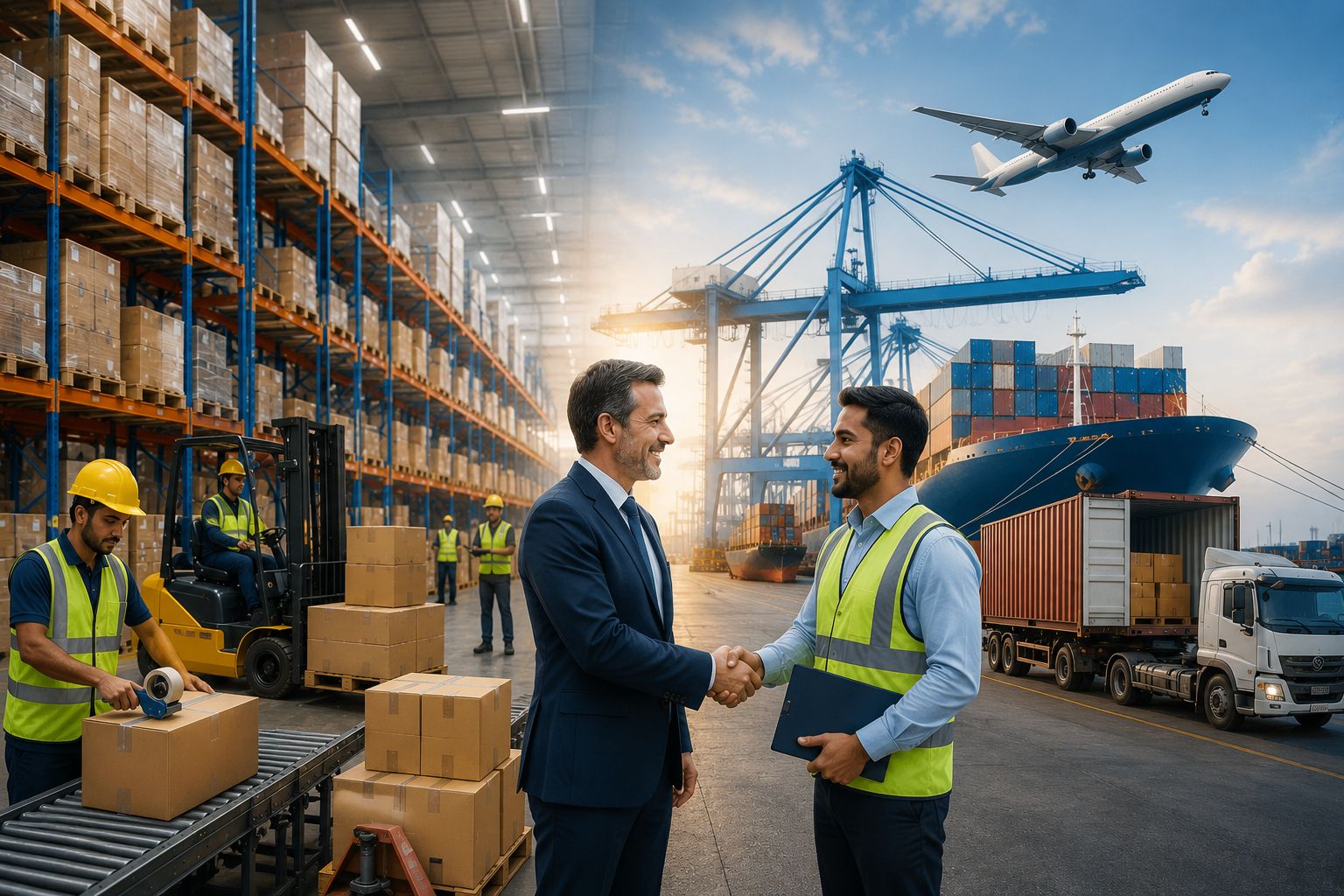
How the Right Warehousing Partner Helps Importers and Exporters Deliver a Better Customer Experience
How the Right Warehousing Partner Helps Importers and Exporters Deliver a Better Customer Experience
When your shipment lands in India, the journey is far from over. How your goods are stored, handled, and dispatched from that point forward has a direct impact on whether your customers receive their orders on time, in perfect condition, and with the confidence to order from you again.
For importers and exporters, warehousing is not just a storage cost — it is a customer experience decision. Choosing the right warehouse and distribution partner determines how reliably your supply chain performs at every touchpoint that your customer actually sees.
Your Customer Does Not See Your Supply Chain — They Feel It
Importers and exporters often think about warehousing in terms of cost per pallet or square footage rates. But your buyers and trade partners do not think in those terms at all. They think about whether their order arrived when it was supposed to, whether the goods were intact, and whether they can depend on you for the next shipment.
Every delay between your cargo arriving at the warehouse and it leaving for the final destination is a delay your customer experiences. Every damaged carton that slips through is a complaint waiting to happen. And every stock error that causes a shipment to be short is an invoice dispute or a cancelled relationship.
The Six Ways Good Warehousing Directly Improves Your Customer Experience
1. Faster Dispatch Means Faster Delivery
When your goods arrive at a well-organized warehouse close to major logistics hubs, they move faster. organized storage zones, efficient inbound processing, and direct connectivity to both air and road freight networks reduce the time between your cargo landing and your customer receiving it.
For importers sourcing goods internationally, shaving even 24 to 48 hours off post-arrival handling time is a meaningful competitive advantage — especially when your competitors are working with slower or more remote facilities.
2. Accurate Stock Management Means No Surprise Shortfalls
One of the most damaging experiences for a trade buyer is placing an order and then finding out days later that the goods were not actually in stock. This happens when warehouses operate with poor inventory control and no real-time visibility into what is physically on the shelf.
A well-managed warehousing operation maintains accurate stock records updated in real time, so your buyers get correct availability information upfront — not an apology after the fact.
3. Secure Storage Means Your Goods Arrive in the Condition They Left In
Cargo damage is one of the leading causes of customer complaints in import-export trade. Goods that are stacked incorrectly, stored in unsecured areas, or handled carelessly during loading result in shortages, breakage, and quality claims that take weeks to resolve and permanently damage buyer confidence.
A professionally managed facility with 24/7 CCTV surveillance, access-controlled entry, fire safety systems, and trained handling staff eliminates most of these risks. Every movement is monitored and documented, giving you and your customer a clear record from receipt to dispatch.
4. Flexible Capacity Means You Can Fulfil During Peak Seasons
Import-export volumes are rarely uniform throughout the year. Festive seasons, trade cycles, and promotional periods create sudden surges that fixed-capacity storage cannot absorb. When your warehouse runs out of space or cannot scale its workforce fast enough, your customers experience delays — even if your supply chain upstream ran perfectly.
Scalable warehousing that adjusts to your volume — up or down — means you can consistently meet customer expectations whether you are shipping 50 pallets a week or 500.
5. Integrated Distribution Means Fewer Handover Failures
One of the most common points of failure in import-export logistics is the gap between the warehouse and the next leg of transport. When warehousing and distribution are handled by different providers who do not communicate well, cargo sits waiting, documentation gets delayed, and carriers miss their collection windows.
Using a provider that manages both warehousing and distribution under one operation closes this gap. Your cargo moves from storage to transit with coordinated documentation, confirmed carrier bookings, and no dependency on third-party coordination that you cannot control.
6. Professional Cargo Handling Means Less Damage, Fewer Claims
How goods are physically handled inside a warehouse — during unloading, storage, retrieval, and loading for dispatch — directly determines the condition they arrive in. Modern handling equipment such as electric stackers and pallet trolleys, combined with trained warehouse staff, reduces handling damage significantly compared to manual or improvised methods.
For importers handling electronics, pharmaceuticals, FMCG, or any high-value cargo, this is not a minor operational detail. It is the difference between a smooth transaction and a claim.
What Importers and Exporters Should Look for in a Warehousing Partner
Choosing a warehousing partner is one of the most consequential supply chain decisions you will make. The wrong choice does not just add cost — it adds risk to every customer relationship you have built.
| What to Evaluate | Why It Matters for Your Customers |
|---|---|
| Location | Close to your key freight lanes, ports, and air cargo terminals. Every kilometre of unnecessary transit adds time and cost. |
| Security infrastructure | 24/7 CCTV, access controls, and fire safety as standard. Non-negotiable for high-value or regulated goods. |
| Handling capability | Trained staff with modern equipment — electric stackers, pallet trolleys, proper segregation areas. |
| Inventory management | Real-time stock visibility, accurate records, and regular cycle counting — not spreadsheets updated once a week. |
| Scalability | Can the facility handle your peak volumes without turning your regular operations into a bottleneck? |
| Distribution integration | Does the provider also manage onward distribution, or will you be coordinating between separate vendors at every dispatch? |
| Air and surface connectivity | For importers, access to both air freight and road transport networks from a single location simplifies logistics significantly. |
How Skyways Air Services Supports Importers and Exporters
Skyways Air Services Limited provides warehouse and distribution services designed specifically for businesses that depend on consistent, professional logistics performance. Facilities are strategically located near major logistics hubs with direct connectivity to air and surface transport networks — making them a practical choice for importers and exporters who need both storage and fast onward movement.
The warehousing infrastructure covers the full range of what trade businesses need: organized storage zones for efficient stock management, round-the-clock security with CCTV and access-controlled entry, modern cargo handling equipment operated by trained staff, and integrated distribution services that reduce the gap between storage and dispatch.
For importers in particular: Having air freight and warehousing managed by the same provider means your cargo moves seamlessly from arrival to storage to final delivery — without the coordination gaps that cause delays and customer complaints.
Capacity is built to scale with demand, supporting businesses through both regular trading periods and seasonal peaks without compromising on handling quality or dispatch speed.
Frequently Asked Questions
How does warehousing location affect my customers’ delivery experience?
A warehouse positioned close to major logistics hubs and air cargo terminals reduces the time between your goods arriving in India and reaching your customers. Shorter transit legs mean faster deliveries, fewer handling touchpoints, and less exposure to damage or delay. For importers, this translates directly into better delivery reliability and stronger buyer confidence.
What is the difference between warehousing and distribution services?
Warehousing covers the receipt, storage, and management of your goods. Distribution services cover the onward movement of those goods to their next destination — whether that is a retailer, a trade buyer, or an end consumer. When both are managed by the same provider, the coordination between storage and dispatch is far more reliable than when two separate companies are involved.
How does cargo security in a warehouse protect my business relationships?
Goods that arrive damaged, short, or tampered with create immediate disputes with your buyers. Professional warehousing with 24/7 CCTV, access-controlled entry, and documented cargo movement gives you a clear audit trail for every shipment. If a dispute arises, you have the records to support your position — and more importantly, the security standards to prevent most incidents from occurring in the first place.
Can a warehousing provider handle both air freight and surface distribution?
Yes, and for importers this is a significant advantage. A provider like Skyways Air Services that manages air freight alongside warehousing and surface distribution means your cargo moves through a single, coordinated operation from arrival to final delivery. This eliminates the handover gaps between separate providers that frequently cause delays and documentation errors.
How do I know if my current warehousing setup is hurting my customer experience?
Look at your complaint data. If you are regularly receiving complaints about late deliveries, damaged goods, short shipments, or incorrect orders, the root cause is often in the warehousing and dispatch stage rather than upstream in procurement or transport. Tracking your order accuracy rate, on-time dispatch rate, and damage claim rate gives you a clear picture of where the gap is.
Good Warehousing Is an Investment in Your Customer Relationships
For importers and exporters, the quality of your warehousing operation shows up in your customer relationships — whether you intend it to or not. Every on-time, accurate, undamaged delivery strengthens trust. Every delay, shortfall, or damaged carton erodes it.
The businesses that grow their import-export operations year on year are almost always the ones that treat warehousing not as a cost to minimise but as a foundation to invest in — because they understand that what happens in the warehouse is what their customers ultimately experience.